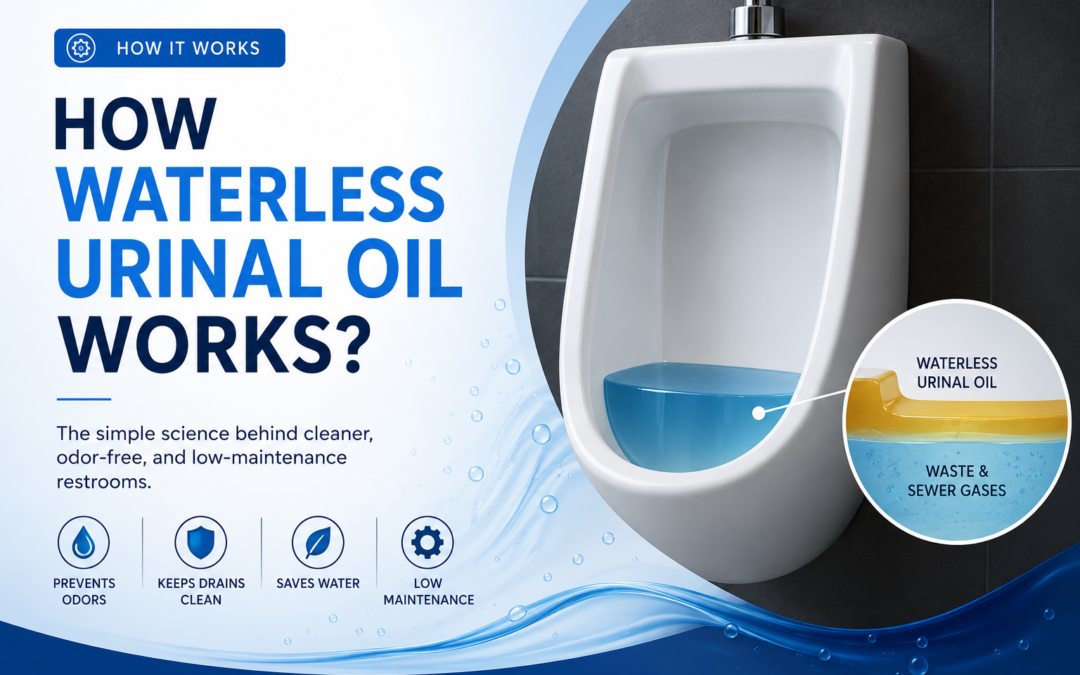
Waterless urinal oil (also called barrier oil, sealant liquid or blocking fluid) is a low-density fluid that floats on top of the liquid in a urinal’s trap to form an odour seal. Because waterless urinal oil is lighter than urine, it settles on the surface as a continuous layer: urine drains down through the oil to the waste pipe, while sewer gas and ammonia odours are sealed off from the washroom. After 15 years supplying and servicing waterless urinals across Australia, this guide explains exactly how the oil works, how much each cartridge needs, and how often to top it up.
The sealing mechanism
Waterless urinal oil works on a density difference. Because the oil is lighter than urine and water, it cannot mix down into the liquid below; instead it rises and stays on the surface as a thin, continuous film over the trap. That floating film does two jobs at once.
- It lets urine drain through. Urine is denser than the oil, so urine sinks straight through the oil layer and drains away, and the seal closes over the top again immediately afterwards.
- It blocks odour from rising. The oil layer acts as a physical vapour barrier, so the sewer gas and ammonia held in the trap below cannot pass up through it and no smell reaches the washroom — without a single drop of flushing water.
Bio-bacterial waterless urinal oils add a second function. These oils carry friendly bacteria and enzymes that digest the organic matter in urine and break down uric salts as they form. This bacterial action prevents the hardened uric scale that otherwise builds up and blocks waterless urinal pipework over time. In short: the oil seal stops the smell, and the bacteria keep the drain clear.
Oil is one of two odour-control methods used in waterless urinals. For the bigger picture — including mechanical cartridge seals, why waterless systems can stay fresher than flush urinals, and how to choose a system for your site — read how odour-free waterless urinals work.
How much oil each waterless urinal needs
The amount of waterless urinal oil needed ranges from 90 ml to 400 ml depending on the cartridge, and the dose is set by the cartridge or trap design rather than by the brand of oil. Each system holds a specific volume of oil to form its seal, and that volume is the same whether you charge a brand-new cartridge or top up an existing one — you refill to the cartridge’s full dose each time. The exact dose for each waterless urinal is below.
| Cartridge / Trap | Compatible Urinal Models | Oil dose |
|---|---|---|
| ZeroFlush Trap Insert | ZF-201, ZF-101, ZF-501 | 400 ml |
| Uridan | Admiral, Admiral Mini, Master, Cadet, Crew, Captain, Pylon, Compass | 300 ml |
| IFO | Ceros | 250 ml |
| Falcon (Velocity) | Boronia, Kea, Flax | 150 ml |
| Ecotrap | Sonora, Anza, GBH, Baja | 90 ml |
How often to top up — and why running costs even out
There is no fixed schedule. Top-up frequency is driven by how heavily the urinal is used, so it varies widely from site to site:
- High-traffic sites — major shopping centres and busy public washrooms can need topping up as often as fortnightly.
- Typical sites — the general recommendation is a top-up roughly every three months.
- Low-use sites — quiet locations can stretch well past the three-month mark, out to six months between top-ups.
There is a useful pattern hidden in the dose table. A cartridge’s oil volume governs how long its seal lasts before it needs refilling: a smaller-volume trap such as the 90 ml Ecotrap depletes sooner and needs topping up more often, while a larger 300 ml Uridan holds its seal for longer between top-ups. Because frequency scales inversely with volume, the total amount of oil used per year tends to land in a similar place across most cartridge types — the small trap sips little and often, the large trap takes more but rarely. For anyone comparing systems on running cost, annual oil consumption is closer than the per-fill figures suggest.
Maintenance & why a seal fails
A waterless urinal only smells when the oil seal is compromised. In practice that happens for a few reasons:
- The oil has run low. The seal depletes gradually through normal use and needs topping up to the full dose for the cartridge (see the table above).
- Harsh cleaning chemicals. Bleach and strong cleaners poured into the urinal strip the oil layer and, in bio-bacterial systems, kill the friendly bacteria. Clean the ceramic surface, not the trap.
- Flooding with water. Pouring large volumes of water into the bowl can wash the oil through, breaking the seal until it is re-dosed.
- Debris in the trap. Foreign objects can disrupt the surface layer and stop it sealing cleanly.
Frequently asked questions
How much oil does a waterless urinal need?
It depends on the cartridge. Doses range from 90 ml for an Ecotrap up to 400 ml for a ZeroFlush Trap Insert. A Uridan takes 300 ml, an IFO Ceros 250 ml, and a Falcon (Velocity) 150 ml. The same volume is used to charge a new cartridge and to top up an existing one.
How often does waterless urinal oil need topping up?
It depends entirely on usage. Busy sites such as shopping centres may top up fortnightly; the general recommendation is around every three months; and low-use sites can go up to six months between top-ups.
Can I use a universal oil instead of the brand’s own?
Yes. Universal barrier oils such as AquaLok oil work in any waterless urinal, and use the same dose as the genuine oil, because the volume is set by the cartridge, not the oil.
Is one waterless urinal cheaper to run on oil than another?
Annual oil consumption tends to be similar across cartridge types. A small-volume trap is topped up more often with less oil; a large-volume trap less often with more. Over a year, the totals converge.
Why does my waterless urinal smell?
A smell almost always means the oil seal has been compromised — usually the oil has run low and needs topping up, or it has been stripped by harsh cleaning chemicals or flushed through with water. Re-dosing to the correct volume restores the seal.
Does the oil let urine drain through?
Yes. Urine is denser than the oil, so it sinks straight through the layer and drains away, and the oil seal closes over the top again immediately.
Need the right oil or a replacement cartridge for your urinal? Waterless Urinal Cartridges or Waterless Urinal Oil — we stock oil for every system in the table above.